How Pet-Paws Are Made
How can a solid bronze paw be created from your dog or cat’s paw? It all starts with a good impression.
1. Paw Impression
After placing your order, the next step is to send us your impression. You can purchase an impression kit from us, or make your own using Play-Doh (store-bought or homemade). You may already have an impression made with clay, soft foam clay, or plaster. I can work with those types of impressions as well.
A good impression is important:
- Not too deep, not too shallow
- The surface should be smooth, level, and flat
- All four paw pads and claws should be visible
- What you see in the impression is what you get in the metal
Learn more about creating a paw impression.
2. Creating the Wax Pattern
When I receive your paw impression, the first step in the studio is creating a wax pattern.
Warm molten wax is carefully poured into the impression. As it cools and solidifies, it becomes an exact replica of your pet’s paw. I then hand-carve the wax, shaping it to the contour of the paw or its specific shape, and refining it into its final form.
This wax paw is called the pattern, and it will be used to create the sand mold for casting.
For impressions made from clay or plaster, wax cannot be poured directly because it would stick and damage the original. In those cases, I first carefully press Play-Doh into the clay or plaster impression to create a secondary impression. Molten wax is then poured over that secondary Play-Doh impression to form the wax pattern. The resulting wax paw is an imprint style.
Another way I create imprint style paws is to make a wax pattern directly from the bronze relief paw. This is how Pet-Paw sets are made. The resulting paws fit together.
3. Building the Sand Mold
The wax pattern is placed into a green-sand mold, which creates the hollow cavity that will later be filled with molten metal.
The sand is packed tightly around the wax pattern (often several at once) in a two-piece mold. Once packed, the mold halves are separated and the wax pattern is carefully removed.
This step requires patience. If there are undercuts around claws or pads, the sand can break or stick to the wax. Using tiny drops of water, I spend time repairing these areas — a process I affectionately call “sand surgery.”
- Channels are carved for molten metal to flow
- Vents are added so gas can escape
- Excess moisture is burned off with a torch
- The two mold halves are secured together, ready to receive molten metal
4. Pouring the Molten Metal
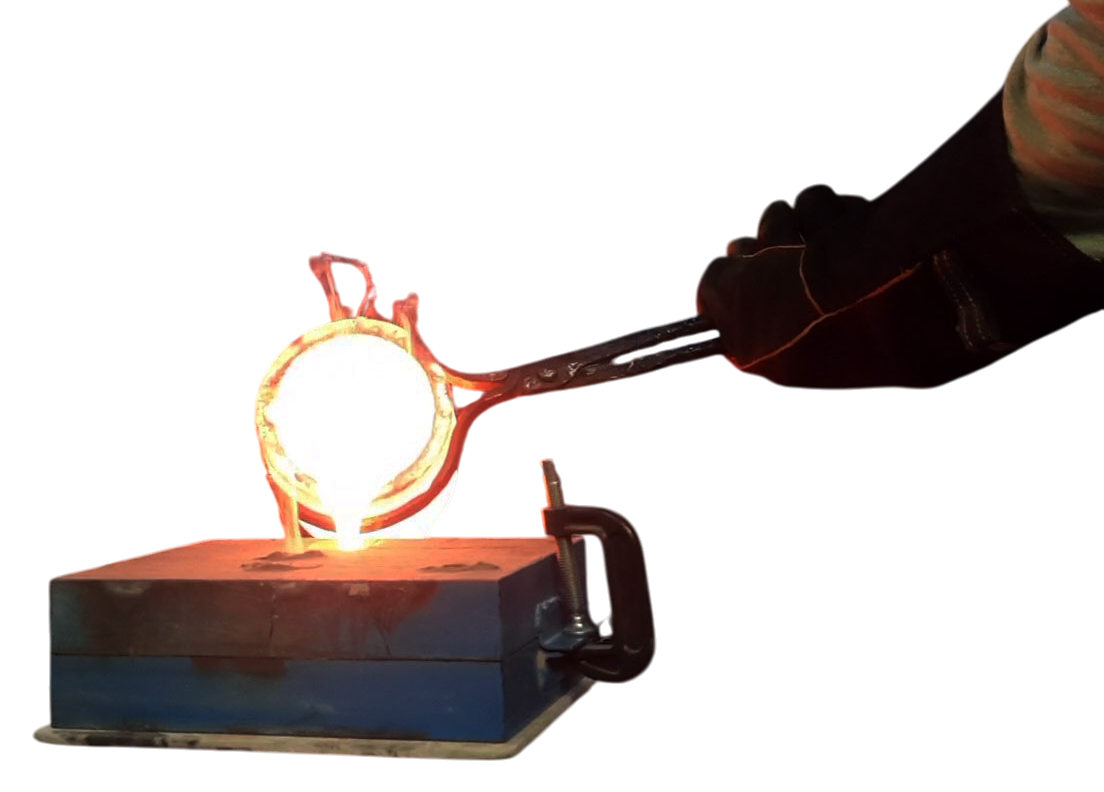
While I am working on the sand mold, the propane-powered foundry is melting the metal inside.
Melting temperatures vary by metal:
- Bronze, brass, copper, and silver: 1650–2000°F
- Aluminum: 1200°F
Once fully molten, the metal is poured like water into the sand mold. It flows through the channels and into the paw cavity as gases escape through vents and the sand itself.
After cooling, the sand mold is cracked away to reveal the metal paw. The casting is still attached to the channeling system, which is cut off before finishing begins.
5. Finishing the Paw by Hand
Each Pet-Paw is carefully finished by hand to bring out its final form and beauty.
First, a mini wire wheel is used gently on the paw’s surface to remove any residual sand and brighten the metal, enhancing the natural texture without altering its unique imprint.
The edge around the paw is ground to its basic shape. Then, the edges are smoothed using progressively finer grits of sandpaper and polished with a buffing wheel to achieve a bright, even shine.
Custom inscriptions are engraved in handwriting on the back of the paw (or the paw’s edge, by request).
6. Embracing Uniqueness
Every Pet-Paw is as unique as the dog or cat it was created from. No two Pet-Paws are ever exactly alike.
- Tiny pits or lines
- Subtle texture variations
- Natural color shifts or patina
These are not flaws, but part of what gives each Pet-Paw its individual character and elegance.
7. Sending Your Pet-Paw Home
After the final polish, your Pet-Paw is cleaned, carefully packaged, and shipped via USPS Priority Mail. Original impressions are usually returned, though Play-Doh impressions are often permanently altered during the wax pattern stage.
8. A Memorial Made to Last
Pet-Paws are cast in solid metal and made to last forever — a tangible connection to the bond you shared with your pet.